Research
Clearance and disposal strategies for Phytophthora-infected rhododendron
Research Status:completed

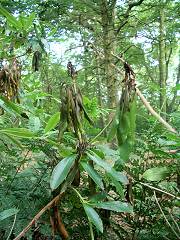
Phytophthora ramorum and P. kernoviae are fungus-like plant pathogens that can cause severe damage and mortality of trees in Britain. One of the main sporulating hosts of both pathogens, on which they can grow and spread into new areas, is Rhododendron ponticum, and this is commonly found growing as a woody weed in British forests and woodlands. Eradication and control of rhododendron is currently one of the most effective control measures to reduce the spread of the pathogen and disease into new areas.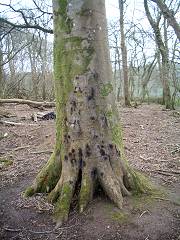
However, eradication of rhododendron poses a number of problems:
This collaborative project was developed to identify new or improved management strategies for the eradication and safe disposal of Phytophthora-infected rhododendron, and methods which reduce pathogen persistence on infected sites.
The project had two strands:
The project draws together experience from field experiments to identify the best management practice for the eradication, containment and remediation of Phytophthora-affected environments, where infected rhododendron forms a significant component.




The collaborative project is funded by Defra (project PH0603) and is implemented by three partners: Forest Research, CABI E-UK and the University of Surrey.
The research project will directly support the Defra Phytophthora Disease Management Programme for P. ramorum and P. kernoviae in England and Wales. The work addresses a key policy objective within the programme to evaluate disease management and control methods. The outputs of the project will support the Disease Management Work Stream of the Programme, which has the aim of eradicating infected sporulating host plants, principally Rhododendron ponticum, an invasive, non-native plant.
The project ran 2010-2013.
For further information contact:
This work area involves a series of field experiments designed to test and evaluate three management strategies:
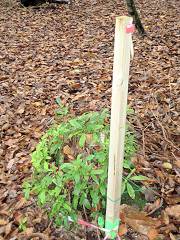
Regrowth of rhododendron 3 months after cutting in a no treatment control plot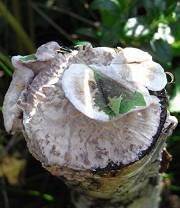
Chondrostereum purpureum growing on a birch stump
Rhododendron is difficult to treat chemically because the uptake of foliar-acting herbicides through the thick, waxy leaves is low. Field experiments have been established to examine the efficacy of a range of chemical herbicides applied as stump treatments to control regrowth of cut infected rhododendron plants. Reducing the amount of infected regrowth and killing infected stumps and root systems would help to reduce inoculum levels on the site.
In addition to the chemical stump treatments trialled, treatments have also been established to investigate the efficacy of the bioherbicide Chondrostereum purpureum (Cp). Cp is a basidiomycete fungus known to suppress the regrowth of target vegetation when applied to cut stumps. The native strain of the fungus has not previously been tested in the field in Britain but may have potential in controlling regrowth of cut rhododendron stumps.
Eight chemical herbicide and bioherbicide treatments are being trialled on a site in Cornwall:
All treatments were applied immediately after cutting. Initial assessments of the fate of inoculum, presence of Cp fruiting bodies and re-sprouting of cut stumps have been carried out at regular intervals since treatment.
In general, all herbicide treatments from both spray dates appear to be very effective at controlling regrowth. The triclopyr treatments appear most effective, followed by picloram and then glyphosate. The biocontrol treatments, or growth medium only treatments, in general do not appear to have been effective at reducing growth, although there are occasional signs of some apparent growth suppression. Biocontrol treatments have not visibly reduced glyphosate efficacy. Regrowth from the untreated controls is strong, and often forms multiple stems.
Final assessments of above ground rhododendron biomass and Phytophthora inoculum levels two years after application are due to commence shortly.
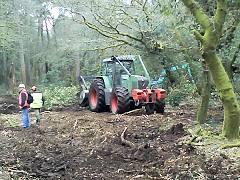
Fendt 970 with FAE mulcher
The third management strategy being investigated is a range of mechanical stump treatment methods. If stem damage is inflicted below the point at which new buds arise, resprouting is prevented. This type of damage can be applied with tractor/excavator mounted flails which, following conventional cutting, destroy stumps in situ, minimising regrowth.
Field trials of five mechanical stump treatments have been carried out on a range of sites with contrasting terrain and vegetation conditions. Mechanical stump treatments being investigated include:
During the efficacy trials, work study has been carried out allowing areas of outputs or work-rates to be determined to derive operational costs for the conditions studied. The efficacy of each treatment in controlling rhododendron regrowth will be assessed shortly, and outputs will allow users to apply to their own machine / labour costs, to assess the costs of working in their own conditions. Health and Safety, environmental site impacts and regional machine availability will be considered and practical recommendations made.
This work area tests and evaluates four innovative methods:
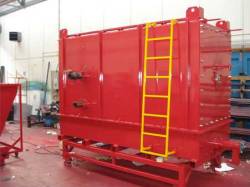
Current methods of disposal of infected material are on-site burning or deep burial in landfill sites. These methods are restricted and expensive.
A review of the extent of Phytophthora ramorum and P. kernoviae infection, current methods of clearing infected material, uses of infected timber, distribution and persistence of infection within the soil, and persistence of infection within felled material has been carried out.
On-site charcoal production using modern portable reactors could be a cost-effective and safe method of disposal of infected material. Optimum charring conditions sufficient to destroy spores and create good quality charcoal have been established at the pilot scale. Yields of 25-33% of charcoal from the original material, releasing 59-78% of the calorific value as heat have been determined for different sections of R. ponticum and L. kaempferi material. Data on the physical and chemical properties of the chars produced from each material type have also been collected. The impact of biomass moisture content on net energy yields, and the potential of net energy produced from charring infected materials to feed soil sterilisation systems are also under investigation.
The potential to use the heat generated to sterilise infected soils is also being investigated, see below.
The heat produced by the charring process has the potential to be converted to steam and be used on-site to sterilise Phytophthora contaminated soil and litter layers.
A review of the range of techniques available for sterilisation of soils has determined that steam injection is likely to be the most effective method. However, although this technique may prove useful in high value, easily accessible sites, such as gardens and nurseries, it may be less practical at the forest scale. Application methods, effects on existing flora and fauna, and energy requirements have been researched. Conflicting evidence on the temperature and duration of steaming required to eliminate P. ramorum from infected soils has been found, and will be summarised and evaluated in the final reports.
Levels of Phytophthora ramorum and P. kernoviae inoculum in naturally infected leaf litter decline naturally as the leaf litter decomposes. Application of nitrogen rich materials such as chicken manure and urea may accelerate the substrate decomposition rate by supporting populations of soil mites and microbes. Some of these microbes may also have a Phytophthora suppressing role.
Replicated trials have been set up to examine the use of chicken manure and urea to treat infected biomass (in the form of woodchips) which may aid disposal of the material and may reduce survival time of the pathogens.
Despite earlier heavy Phytophthora infection at the trial sites, inoculum levels in the initial trial were found to be very low, probably due to dry weather conditions. New trials established in Autumn 2011 are now underway to monitor the impact of the treatments on decomposition rates and inoculum levels of infected woodchips. Early results indicate that both urea and chicken manure can increase the rate of woodchip breakdown; however, as infection rates were again very low, no significant impact of the treatments on Pr or Pk infection was observed. Larch woodchips have been found to yield higher levels of Pr compared with rhododendron woodchips, but these differences may reflect higher levels of infection and sporulation on larch foliage compared with rhododendron.
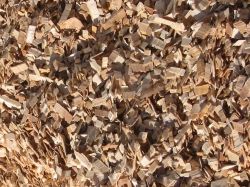
Mild heating of wood shavings has recently been found to confer short-lived anti-microbial properties, and may be suitable for treating infected rhododendron and larch material. It is thought that heating eliminates Phytophthora from infected wood, and that after chipping, incorporation of the treated chips into the soil would reduce the amount of inoculum present in the soil.
Initial experimental work has demonstrated a highly significant inhibitory effect of heated rhododendron, Scots pine and larch wood shavings on the growth rates and infection rates of Phytophthora in lab-scale microcosm studies. Further work has been carried out to identify the inhibitory compounds and combinations of compounds, and to establish their relative inhibitory activity against Pr and Pk.
Minimal inhibitory concentrations of the active compounds have been determined for different isolates of Pr. Several active compounds have been identified, with conifer aldehyde showing the most biological activity against both isolates of Pr. In addition, the compounds vanillin and acetovanillone showed activity against Pr when in combination with either abietic or dehydroabietic acid.
The next stage of the project will focus on evaluation of inhibitory effect of heat treated woodchips in microcosm and field studies.

Principal Pathologist