What causes Dothistroma needle blight?
What species are susceptible?
What are the symptoms?
How did the outbreak of DNB develop in Great Britain?
Why has this become a problem now? Is it related to climate change?
What research is being undertaken into this disease?
Spread
How is it spread?
Where else is it found?
What information do we have on the current position in Great Britain?
Which are the worst affected forests?
How many pines are there in Great Britain?
What is the total area of Corsican,lodgepole and Scots pine in Britain?
What proportion of FC forests are planted with pine?
What are the average economic rotation lengths for pines in Britain? When did planting with pine start, and why?
Impact
What impact does the disease have on timber yield?
Is there any risk to christmas trees? What are the restraints on using fungicides?
Are there movement restrictions on any infected nursery stock? Are there movement restrictions on other infected material?
Nurseries
Has the disease been found in forest nurseries?
How do you monitor this?
What happens when infected plants are found?
What about stock in the nursery on which the disease isn't found?
Will there be compensation for nurseries that are now unable to sell their stocks of infected seedlings?
Prevention and Advice
Will you order owners to destoy infected trees in woodlands or to put movement restrictions in place?
Do I need to notify someone if I find the disease?
What controls are in place to prevent further introductions?
How can I manage the disease?
What proportion of trees are taken out when thinning a forest to reduce humidity in the forest canopy?
What are the main alternative species to pine?
What happens in other countries? Are the affected species still being planted?
Grant Aid
Will grant aid for pine planting continue to be available?
Under what circumstances would grant aid for pine be rejected?
If grant aid was paid and the planting subsequently failed because of DNB, would we reclaim the grant?
Why has the FC stopped planting Corsican pine (and also lodgepole pine, in Scotland) in its own woods, but has not ordered other woodland owners to do so too?
The Disease
What causes Dothistroma needle blight?
In Great Britain, Dothistroma needle blight (also known as red band needle blight) is caused by the fungus Dothistroma septosporum, although a closely related species, Dothistroma pini, has been found causing the disease in parts of North and Central America, the Ukraine, south–eastern Russia and more recently France and Hungary.
The disease has been found on a range of conifer species throughout the world. Pine species are by far the most common hosts, with more than 80 species reported to be prone to infection. Until recently Corsican pine (Pinus nigra ssp. laricio) was the main species affected in Britain, particularly in England. However, surveys have shown that a significant number of lodgepole pine (Pinus contorta var. latifolia) stands are also infected, and there is now evidence that Scots pine (Pinus sylvestris) is more susceptible than we initially thought. The disease has also been found on a number of other pine species and several other conifer species.
We are particularly concerned about Scots pine, Britain's only native pine tree.
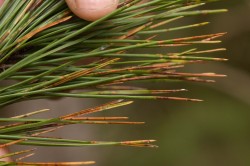
Trees of all ages can become infected. Symptoms are first seen at the base of the crown on older needles. Infected needles typically develop yellow and tan spots and bands, which soon turn red. As the disease progresses, the ends of the needles then turn reddish-brown whilst the needle base remains green. It is within the red bands that the small black spore containing fruit bodies tend to be found, with symptoms being most apparent in June and July. Spores are released from the fruit bodies during this period, leading to infection of the current year's needles. After this point, the symptomatic needles are shed, and branches can have a typical 'lion's tail' appearance, with only a tuft of the recently infected current year's needles remaining at the branch ends. This defoliation can continue year on year and gradually weaken the tree, significantly reducing timber yields and causing mortality.
How did the outbreak of DNB develop in Great Britain?
DNB was first recorded in Great Britain in 1954 on nursery stock in Dorset, where it recurred sporadically until 1966. Apart from occurrences in forest stands in Wales in 1958 and 1989, there were then no reports of the disease until the late 1990s. Between 1997 and 2005 the majority of reports were on Corsican pine in East Anglia, although it was identified in several other parts of Great Britain during this period. In 2006 a GB-wide survey of Forestry Commission forests found the disease to be present within 70% of Corsican pine stands. Since then, annual surveys in Scotland have revealed the disease to be present on numerous stands of lodgepole and Scots pine.
Why has this become a problem now?
The severity of the disease epidemics has increased in other European countries as well as in North America on lodgepole pine. The increase in geographic extent and intensity of the disease in Britain is probably due to a combination of factors including favourable climatic conditions i.e. high spring and summer rainfall, availability of suitable hosts, a genetically diverse and virulent fungal population, and possible movement of the pathogen through the plant trade.
Is it related to climate change?
We cannot be sure of the role of climate change. It is unfortunate that Corsican pine in Britain has proved particularly susceptible to DNB, because it is a species that we predict would otherwise have been well suited to the likely future climatic conditions in parts of Great Britain over the next 50-100 years.
What research is being undertaken into this disease?
The research programme includes: disease monitoring and surveillance; assessment of disease impacts; i.e. mortality rates and losses in timber yield; increasing our understanding of the fungal biology and disease epidemiology to aid management decisions; investigations into management options, including host susceptibility and the impact of different forest management practices on the incidence and severity of the disease. It is being led by Dr Anna Brown of Forest Research, the Commission's scientific research agency, based at Alice Holt Lodge Research Station in Surrey.
Spread
Moisture is required for natural dispersal of the fungus, and long-distance dispersal is thought to occur in moist winds and mists. Movement of infected plant material, including infected needles on footwear, clothing, machinery and timber, could also potentially spread the disease.
The origin of the disease is unknown, although both the Himalayas and South America have been suggested as possibilities. Until recently the disease was primarily of concern in the Southern Hemisphere, particularly on radiata pine. However, since the 1990s there has been an increase in its incidence in the Northern Hemisphere, particularly on sub-species of black pine and Scots pine in Europe. Since 2000 there have been 14 reports of the disease for the first time in European countries from Turkey to Northern Finland. It has also been a major problem on lodgepole pine in Canada since the 1990s.
What information do we have on the current position in Great Britain?
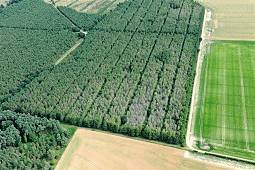
Surveys have been undertaken in Forestry Commission forests since 2003. In 2006 the disease was found on Corsican pine in all of the Commission's Forest Districts in England, the majority in Wales and several in Scotland. Overall, 70% of the Corsican stands inspected had the disease, and it is estimated that 44% of these infected stands had crown infection levels greater than 30%. Furthermore, between 2007 and 2011 the disease has been identified in over 450 new stands (lodgepole pine, Scots pine and Corsican pine), with significant mortality occurring in some lodgepole pine stands, particularly in the east and north of Scotland. The disease is now also present in all the Commission’s Forest Districts in Scotland.
Which are the worst affected forests?
The largest areas of infected Corsican pine are found in the east of England, but the disease is also having a significant impact on this species elsewhere in England, Scotland and Wales. To date, the greatest impact on Scots and lodgepole pine is being seen in forests in Moray, Aberdeenshire and the North Highlands.
How many pines are there in Great Britain?
We estimate there are about 409 million pine trees in Britain (calculated as 409,000 hectares x an average density of about 1000 stems per hectare at mid-rotation).
What is the total area of Corsican, lodgepole and Scots pine in Britain?
England - 41,000 ha CP; 7000 ha LP; 82,000 SP
Scotland - 2,000 ha CP; 122,000 ha LP; 140,000 ha SP
Wales – 3000 ha CP; 6000 ha LP; 5,000 SP
Great Britain - 47,000 ha CP; 135,000 ha LP. 227,000 ha SP
(Discrepancies in totals are due to rounding.)
What proportion of FC forests are planted with pine?
CP - 30,000 ha or 4%
LP - 80,000 ha or 10%
SP - 73,000 ha or 9%
What are the average economic rotation lengths for pines in Britain?
CP – 45 to 65 years
LP – 45 to 65 years
SP – 50 to 80 years
When did planting with pine start, and why?
Scots pine is one of only three native conifer species in Britain (yew and juniper being the others). Caledonian pinewoods in Scotland and estate planting of Scots pine date back hundreds of years.
Records show planting of Corsican pine on what is now FC woodland going back to 1859 in the New Forest. However, planting probably really started in earnest in the 1920s and 1930s due to its good form and high timber yields throughout the rotation. In recent years Corsican pine was increasingly the species of choice as an adaptation strategy to climate change predictions, and was considered a key species for the future in much of England.
Records show planting of lodgepole pine on what is now FC woodland going back to 1910 in Morayshire. Certain provenances of this species that had high growth rates have not performed as well as hoped in terms of timber quality. Other provenances have performed well although the amount of lodgepole pine planted in Great Britain has been declining in recent years. The species grows well on certain poor soils that other species struggle in without high levels of fertilisation. Although its timber qualities for end uses such as construction are less than optimum, it is useful as woodfuel and pulp. The trees also makes an excellent "nurse" crop, that is, a sacrificial crop used to improve early-years shelter and nutrition for other, final crop species planted among it. It plays a specific role in helping Sitka spruce (Picea sitchensis) to grow on unflushed peats where heather competition and nitrogen deficiency would otherwise require the application of herbicide and/or fertiliser for successful crop establishment. Young lodgepole pine are popular as Christmas trees, and are able to produce prolific cone crops that offer a valuable source of seed for animals and birds.
Impact
What impact does the disease have on timber yield?
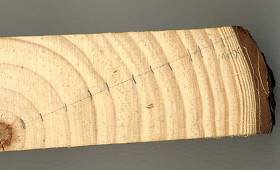
Trials on young radiata pine in New Zealand found that the percentage of crown infection equates to the percentage yield reduction, and the same trend has also been observed in initial trials on Corsican pine.
Is there any risk to Christmas trees?
Both the Forestry Commission and the private sector have significant plantations of lodgepole pine Christmas trees, predominantly in Scotland. This species is susceptible to infection, and where the disease was identified in one such Christmas tree plantation in the north of Scotland it was felled prematurely in 2008. If other plantations were to become infected it could have a significant economic impact, because the disease causes premature defoliation (needle loss), reducing the aesthetic value of the tree. The British Christmas Tree Growers' Association has been kept informed of the position. Fungicides approved for ornamental plant production could potentially be used within a specialist, horticultural Christmas tree farm (i.e. where the crop situation is 'ornamental plant production '). However, they cannot be used on Christmas tree production within a forest block, because for the purposes of pesticide approvals this is defined as a 'Forest' crop. Refer to the Chemicals Regulation Directorate for further information on pesticide approvals and always read and comply with the fungicide product label before making any applications.
What are the constraints on using fungicides?
There are regulatory, environmental, health and safety, and economic constraints. Before we can use them, we need to consider any potential issues they might cause in the local environment or for users' and neighbours' health and safety, and we need to assess whether their use would be cost-effective. There are also legal restrictions which limit which fungicides can be used in any given situation. As for all pesticide use, prior to application, reference should be made to the relevant codes of practice (see http://www.pesticides.gov.uk/safe_use.asp?id=64 for England and Wales and http://www.scotland.gov.uk/Publications/2006/12/19110050/0 for Scotland) in addition to the pesticide approvals document and product label.
Are there movement restrictions on any infected nursery stock?
Within the European Union the movement of pine plants intended for planting is regulated though plant passport arrangements. Our plant health authorities inspect growers of pine each year, and only grant authorisation to issue passports if a place of production and its immediate vicinity is free from DNB. In the event that DNB is found on plants, they must be destroyed and authorisation to issue passports will not be granted for that place of production. In exceptional cases authorisation may be granted to move asymptomatic pine to specified regions within Britain where DNB is already present. Growers of pine plants for planting are obliged to inform the relevant Plant Health Authority if they suspect that DNB is present.
Are there movement restrictions on other infected material?
There are no movement controls on logs, sawn wood, cut trees (e.g. Christmas trees), branches, foliage or seeds, because these products are not considered a significant pathway for spreading the disease in the natural environment. However, visitors to nurseries should adopt appropriate biosecurity measures to prevent unintentional movement of infected material from the natural environment.
Nurseries
Has the disease been found in forest nurseries?
Yes: infected plants of Corsican, lodgepole, Scots pine, Ponderosa pine and Bishops pine (Pinus muricata) and black pine (Pinus nigra) have been confirmed at FC and privately owned nurseries in England and Scotland.
Plant health inspectors carry out surveys of pine plants in all nurseries that grow pine for sale. Furthermore, if inspectors find any infection within 550 metres of a nursery, then movement of pine species will be restricted
What happens when infected plants are found?
The nursery will be informed about the finding and will be served with a notice to destroy infected stock by a certain date. If further investigation is required then a notice to prohibit plant movement will be served until such a time as the outcome of the investigation is complete.
What about other stock in the nursery on which the disease isn't found?
Authorisation to grant plant passports will not be given for susceptible pine species growing in the nursery until they have been demonstrated to be free of infection for one full growing cycle, which may be up to two years, depending on when the infection is first discovered. Other genera, such as spruces, firs and larches, are not covered by these restrictions.
The Forestry Commissioners have no powers to pay compensation, and historically it has been the policy of successive governments not to pay compensation for plants and trees lost through pests and diseases or the measures required to eradicate them. This remains the case today.
Prevention and Advice
We are not contemplating any statutory controls in infected woodlands. Due to the scale of the problem we do not believe that large-scale felling as a disease control measure would be either practicable or cost-effective. We are, however, researching less-drastic control techniques so that we can advise woodland owners on how best to minimise the impact of the disease.
Do I need to notify someone if I find the disease?
If you find the disease in a nursery or garden centre, you must report it to a local Defra Plant Health & Seeds Inspector in England and Wales (or their central helpline 08459 335577) or, in Scotland, to Scottish Government Rural Payments & Inspections Directorate's Horticultural Marketing Unit (tel: 0131 244 6303). There is no statutory requirement for notification if it is found in woodland or other mature trees. Although there is no requirement to report the disease on mature and woodland trees, it would be helpful for monitoring disease spread if newly discovered outbreaks in Wales and Scotland could be reported to the Anna Brown, Forest Research.
Irrespective of the above statutory position, it is strongly recommended that woodland owners and their agents need to be aware of the distribution and severity of DNB on and adjacent to their land so that appropriate management strategies can be put in place as part of their overall risk management.
What controls are in place to prevent further introductions?
Dothistroma septosporum, also sometimes called Scirrhia pini or Mycosphaerella pini is a listed as quarantine organism under the EU Plant Health Directive and the Plant Heath (Forestry) Order 2005. Imported plants for planting from all countries the EU must come from nurseries known to be free of the disease. Imports of pine trees for planting from all non-European countries are prohibited to prevent the introduction of a number of pests and diseases, including the related pathogen Dothistroma pini.
Top
Further planting of Corsican pine is not recommended and has been suspended in FC woodland. Planting of lodgepole pine has also been suspended in FC Scotland woodlands, as has the planting of asymptomatic Scots pine within 550m of known uninfected pine crops or in Caledonian pinewood areas. Woodland managers should consider carefully the risks of continuing to plant any pine species in areas where infection is known to occur, and whether their objectives could be better achieved by planting alternative species. The main management option to minimise infection in existing woodland is to ensure that all stands are kept well thinned to facilitate air movement and lower humidity in the canopy. This will not, in itself, prevent infection, which may be blown in the wind from neighbouring infected stands, but it will help to minimise its impact. Research is also under way to assess the relative susceptibility of different provenances of Scots and lodgepole pine.
It is known that reducing the humidity levels can reduce the level of infection, so good weed control is important with young crops, including nursery stock. For older crops, thinning is the main management option available to facilitate air movement and lower humidity in the canopy. Delayed first thinning and no-thin regimes have been shown to lead to significant mortality in Forestry Commission forests.
At present there are no plant protection products with approval that can be used in infected stands in a forest context. However, use of copper-based fungicides is permitted in amenity situations, and this can suppress the symptoms and might be a realistic option for individual or small groups of specimen trees. Fungicides may also be used on nursery stock, horticultural Christmas tree farms and amenity crops.
Further details are available in our Research Note. Forest managers are also welcome to consult their Forestry Commission Regional or Conservancy offices for advice.
The proportion of Corsican pine trees taken out at first thinning is about one-third, or about 800 trees per hectare (they are planted at a density of about 2500 trees per hectare initially). The proportion declines with each subsequent thinning, so that by the fourth and fifth thinnings only about one-fifth of the remaining trees are removed. We are still learning what the ideal thinning regime is to protect crops against Dothistroma needle blight, so these figures might change over time.
What are the main alternative species to pine?
This will vary dependent on site conditions and the owner’s objectives. Forest managers are also welcome to consult their Forestry Commission Regional or Conservancy offices for advice.
What happens in other countries? Are the affected species still being planted?
Planting of host species has been stopped in some other countries, notably radiata pine in East Africa and Corsican pine in New Zealand. Corsican pine is also no longer being planted in parts of France.
Grant Aid
Will grant aid for pine planting continue to be available?
Yes. We will continue to make grant aid available to forest owners to plant or restock with pine, and we will continue to honour existing grant contracts. However, we will be advising forest managers to take account of the local risks posed by Dothistroma needle blight for pine establishment. Where existing contracts include pine we will be willing to amend the contracts to use appropriate alternative species.
We are keeping the grants position under review for all pine species. We will consult the industry if we believe there is a need to make any changes.
Under what circumstances would grant aid for pine be rejected?
If the planting of pine is central to a proposal, the local Dothistroma needle blight situation will need to be considered in relation to the long-term viability of pine in that area. In this circumstance we would give careful consideration to the overall percentage of pine in the planting design and only agree grant payments where there appeared to be a good prospect of establishing tree cover within the conditions of the grant contract.
If pine is not central to the planting design, it is likely that alternative species would be recommended.
If grant was paid and the planting subsequently failed because of DNB, would we reclaim the grant?
If any grant-aided project fails to meet its objectives, then yes, reclaim would be our fall-back position if remedial action were unsuccessful. However, if pine looks likely to fail within the required period, the owner would have at least two options to avoid a reclaim: continue replanting pine until it survives at a stocking density which meets the contract requirements, or, by agreement with the Commission, replant an alternative species. Both would be at the woodland owner's expense.
In the forests we manage, we think planting Corsican pine carries a significant and unacceptable risk of failure. In Scotland, as a precautionary measure pending further information, the planting of lodgepole pine has also been temporarily suspended on the national forest estate. However, where possible the Commission prefers not to dictate to other woodland owners what they may or may not plant. In this case we are giving owners advice and thereby allowing them to make their own decisions based on their own unique circumstances and objectives. Any failure of pine planted by others is at their own risk.
Top